A couple of high-profile entries in the civic conversation about the politics of small-scale farming--one in the New York Times and a response on Huff Post's Green blog--show some heartening, if also still small-scale, historical perspectives on the odds of making it as a farmer in the U.S.
Bren Smith's much-discussed piece in the Times, "Don't let your children grow up to be farmers" (August 9, 2014), noted how farmers' long-standing problems of debt, access to land, and competition are playing out within today's food movement. He points to the proliferation of CSAs, hobby farms, and non-profit farm projects as a new pressure within the marketplace, and notes that like most farmers, he's had to supplement his income with other kinds of work in order to keep his farm going.
Interestingly, he also looks to earlier "food movements" of the late nineteenth century, the Depression era, and the 1970s as models for the kind of direct political action and advocacy that he thinks today's small-scale farmers need to embrace more seriously.
Showing posts with label farm policy. Show all posts
Showing posts with label farm policy. Show all posts
Thursday, September 4, 2014

Sunday, April 7, 2013
Plowing Boston Common
 | ||
| "Victory Garden Program. Secretary Plowing Boston Common, 04/11/1944" |
I love lots of things about the photo, but particularly the fact that they're using draft horses, which seems to suggest either that they were going for an "olde tyme" kind of association or trying to make a point about conserving fuel during the war (or maybe both). And it raises so many questions for me, including where these guys in suits learned to plow with draft animals!
~ Cathy
Wednesday, December 19, 2012
Bread wars and problems of plenty: Lessons from the early market society
 |
| An 1805 map of the property that became Van Buren's farm |
First, thinking through the ways that farming in the northeastern states changed during this period left me firmly convinced that large-scale capitalism and small-scale agriculture are fundamentally at odds. By "large-scale" I mean not just global or corporatized, but pervasive in its adoption of a logic that foregrounds efficiency in search of maximum profitability. In agriculture, that logic has historically taken us down the road toward increasing mechanization, consolidation of small properties into larger and more expensive farms, pricing based on often-distant and often-volatile markets rather than local circumstances or costs of production, and other trends that eventually led to a fully industrial, commoditized food system not accountable to local markets or conditions. The seeds of what some have termed the "paradox of plenty" [1] or "problems of plenty" [2] were sown in this period, with efficiency and consolidation leading to lower prices and greater abundance for consumers, but driving small farmers out of business and leaving the rest chasing an ever-receding threshold of profitability.

And my second takeaway is the realization that despite some level of early 19th century prescience about the problems inherent in letting those more generalized "laws" of supply and demand determine how food would be grown and sold, no one had enough experience yet with capitalist markets to see where this all might lead. As the riskiness of those markets became clearer--for example, after the Panic of 1819, one of the first systemic economic crises in the new republic--various efforts to strengthen and improve agriculture in the old northeastern states emerged. But the irony of these projects is that they often involved pursuing exactly the same kinds of strategies--efficiency, higher yields, open markets--that were undermining the ability of small farmers and other food producers to survive in the longer term.
 |
| The New York of 1803, caught in bread wars |
The bakers were trying to assert their right to a fair piece of the emerging market economy, just as small farmers were. But both groups miscalculated, failing to understand their relative lack of power within a system increasingly dominated by concentrated capital and the unforgiving logic of efficiency. New York's bakers finally managed to get the assize of bread abolished in 1821, but their organizing had irked a group of New York financiers who saw older artisanal guild networks as a barrier to free trade. These well-heeled investors responded to the bread crisis by launching a new corporation, the Bread Company, that could provide cheaper bread to consumers. By helping to create the legal underpinnings for a more wide-open market system, farmers, artisanal producers, and their allies among politicians and reformers actually made small farmers and producers much more vulnerable to large-scale competition and economic volatility.[3]
The really big takeaway here, and the reason why I think this particular period of history is well worth present-day food and farm reformers knowing more about, is that it shows how the attempts to compromise and chase after the new efficiencies demanded by capital-oriented markets in order to keep small-scale food production functional ultimately had exactly the opposite effect. This history lends weight to contemporary efforts to re-scale our food systems so that they are once again more accountable to regional and local conditions and markets. The "lessons" of the past aren't usually directly applicable to the present, but there can be a great deal of benefit from being able to say to those who argue for a fully market-oriented food system, "Look, we tried that, and here's why it didn't work."
Next: Martin Van Buren buys a farm and Cathy struggles with presentism.
SOURCES
[1] Harvey Levenstein, Paradox of Plenty: A Social History of Eating in Modern America (Oxford University Press, 1993).
[2] R. Douglas Hurt, Problems of Plenty: The American Farmer in the 20th Century (Ivan R. Dee, 2002).
[3] The assize of bread is discussed in Chapter 7 of Howard Rock's Artisans of the New Republic: The Tradesmen of New York City in the Age of Jefferson (New York University Press, 1984).
The 1805 map is by William Dickie, "A survey of the lands of John and William Van Ness...on the West Side of the Albany Road in Kinderhook" (from the collection of Martin Van Buren NHS).
Tuesday, January 17, 2012
Is a farm policy museum too wonky to work?
One of the frustrations for small-scale farmers and food-sellers is the existence of massive amounts of state regulation that has developed over decades of increasing government involvement in the food system, often in response to abuses and problems within large-scale industrialized agriculture. The big growers and processors follow practices that create a higher risk of contamination--the 2006 E. coli outbreak in California spinach showed this in a high-profile way--prompting oversight and stricter rules that smaller farms have to abide by but usually can't afford.
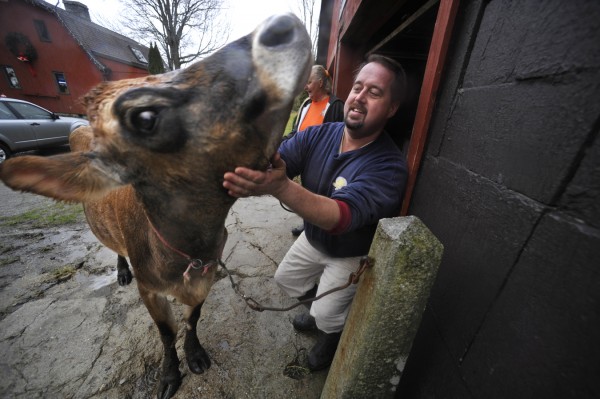
 A case last month in Blue Hill, Maine, reduced this situation to its lowest denominator: a man who farms largely to feed his own family and sells what he doesn't need to his neighbors, all of whom know him and have to come to his farm to pick up what they buy from him. It's a mode of farming that was extremely widespread in this part of the world in the 18th and early 19th centuries (and sometimes far later, in places). As the farmer, Dan Brown, points out in a Bangor Daily News article, "This has been done this way for hundreds of years." It's the ultimate in direct marketing: the warrant for the food's safety comes from personal relationship and knowledge that the farmer himself is consuming what he (and his single cow, in this case) produces.
Now, of course (you saw this coming), there's been a complaint about the unregulated nature of Brown's milk production and sales, and the state is pushing him to get a distributor's license and come under the official umbrella. Brown is digging in his heels and his situation is shaping up to be a potential test case in the pushback against big rules being applied to small farmers. The controversy over the selling of raw milk is at the forefront of this struggle, but the issue is larger than any single product. It goes to the heart of the differing economic and social visions and realities represented by small-scale production and direct marketing, on the one hand, and large-scale commodity farming, on the other.
It also, it seems to me, has a lot to do with history--in this case, the history of how and why the state got so embroiled in the business of food. It's a real paradox of our food system that much of what's wrong with it--for example, the heavy hand of government regulation and the move toward mechanized production--is actually a result of well-intentioned people trying to keep farmers on the land and help them make a living in an economic system whose logic of efficiency and economies of scale is in many ways fundamentally at odds with what it takes to keep farms and farming viable. Knowing more about that history may not fix anything in the short term, but it could be a useful lesson in how easy it is to end up with unintended consequences when you're trying to sort out the uneasy (or maybe even unholy) marriage of agriculture and capitalism.
What would a museum devoted to that history look like? And does one actually exist? A fairly cursory Internet search turned up the USDA's Agricultural Research Station National Visitor Center in Beltsville, Maryland, which closed last fall (possibly because only a few thousand visitors a year found their way there) and which seemed, in any case, to be in the standard mode of show-casing innovations and inventions rather than talking about agricultural policy in a larger sense. The National Agricultural Library, also in Beltsville, has a fabulous collection of materials, some of which are available online, but they're not in the exhibition business in the way that museums are. I didn't find anything that came close to what I'm envisioning here: a museum, or at least an exhibit, that illuminates the complicated history of state regulation and intervention in the farm sector, for better and worse.
Policy history is kind of a tough sell, especially in competition with baby lambs and heirloom apples--but I'm thinking it would have a great deal of utility as we try to sort out how we got into a lot of the problems we're currently trying to get out of. What do you think? Too wonky to work?
Now, of course (you saw this coming), there's been a complaint about the unregulated nature of Brown's milk production and sales, and the state is pushing him to get a distributor's license and come under the official umbrella. Brown is digging in his heels and his situation is shaping up to be a potential test case in the pushback against big rules being applied to small farmers. The controversy over the selling of raw milk is at the forefront of this struggle, but the issue is larger than any single product. It goes to the heart of the differing economic and social visions and realities represented by small-scale production and direct marketing, on the one hand, and large-scale commodity farming, on the other.
It also, it seems to me, has a lot to do with history--in this case, the history of how and why the state got so embroiled in the business of food. It's a real paradox of our food system that much of what's wrong with it--for example, the heavy hand of government regulation and the move toward mechanized production--is actually a result of well-intentioned people trying to keep farmers on the land and help them make a living in an economic system whose logic of efficiency and economies of scale is in many ways fundamentally at odds with what it takes to keep farms and farming viable. Knowing more about that history may not fix anything in the short term, but it could be a useful lesson in how easy it is to end up with unintended consequences when you're trying to sort out the uneasy (or maybe even unholy) marriage of agriculture and capitalism.
What would a museum devoted to that history look like? And does one actually exist? A fairly cursory Internet search turned up the USDA's Agricultural Research Station National Visitor Center in Beltsville, Maryland, which closed last fall (possibly because only a few thousand visitors a year found their way there) and which seemed, in any case, to be in the standard mode of show-casing innovations and inventions rather than talking about agricultural policy in a larger sense. The National Agricultural Library, also in Beltsville, has a fabulous collection of materials, some of which are available online, but they're not in the exhibition business in the way that museums are. I didn't find anything that came close to what I'm envisioning here: a museum, or at least an exhibit, that illuminates the complicated history of state regulation and intervention in the farm sector, for better and worse.
Policy history is kind of a tough sell, especially in competition with baby lambs and heirloom apples--but I'm thinking it would have a great deal of utility as we try to sort out how we got into a lot of the problems we're currently trying to get out of. What do you think? Too wonky to work?
Subscribe to:
Posts (Atom)